
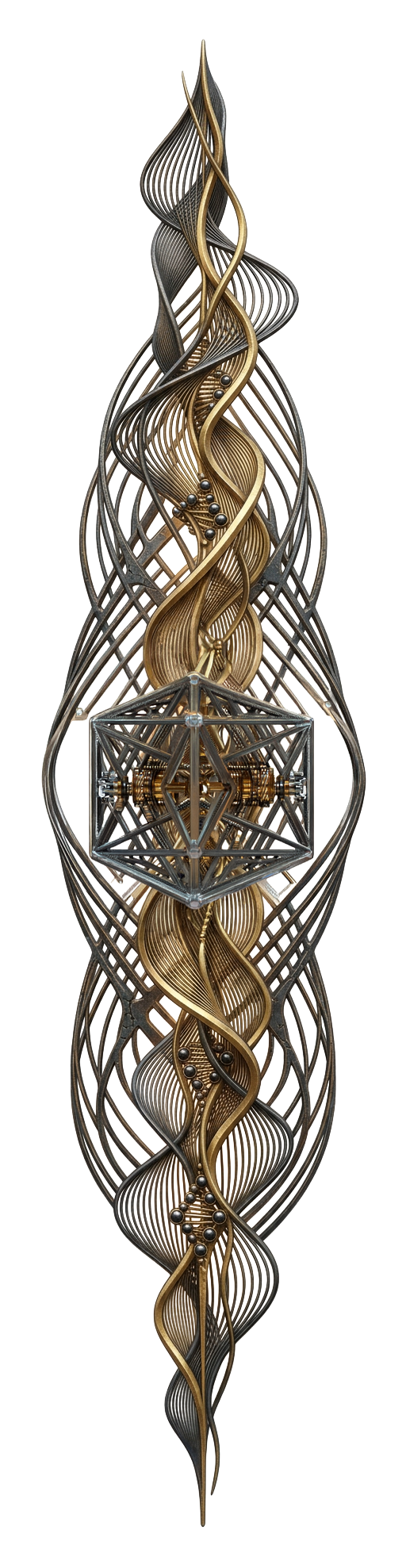
The Boundary Layer
A boundary between two things isn't an empty line — it's where new structure actually gets made.
The boundary layer is the zone where two differentiated states meet — not a line that separates them, but an active interface that generates something neither one contains alone.
Picture the exact moment fine sand strikes the surface of still water. There's the sand — solid, falling under its own weight. There's the water — liquid, holding its surface tension against the impact. And then there's the boundary layer: the precise zone where the two meet, generating a burst of turbulence, displaced droplets, structure that belongs to neither the physics of the sand nor the physics of the water, but to their interaction. This is the same pattern the Generative Rule depends on. When a system divides, the boundary between the resulting states isn't empty space — it's where exchange actually happens, where information gets generated, where structure becomes visible for the first time. Without activity at that boundary, division stays inert and expression never occurs.
A boundary does not only create separation between two rigid constructs but also produces within itself; a new space, containing a spectrum of all the possibilities of integrations that sustain, even if only momentarily.
It's tempting to think of a boundary as the edge of something — the place where one thing stops and another begins. At the level of actual interaction, a boundary behaves more like a site of continuous exchange than a line of separation. What looks like a stable edge from a distance is being actively regenerated by whatever is happening at that interface, moment to moment.
This is why systems are better analyzed at their interfaces than at their static points — change doesn't originate in the parts on either side of a boundary. It originates at the boundary itself, in what their meeting generates. The same structural pattern also appears in a fuller physical account of existence developed separately on Substack, in A Boundary Layer Model: The Field We Share — but the pattern itself, as described here, is complete on its own.
Why This Matters
Misunderstanding boundaries leads to incorrect assumptions about where change occurs.